
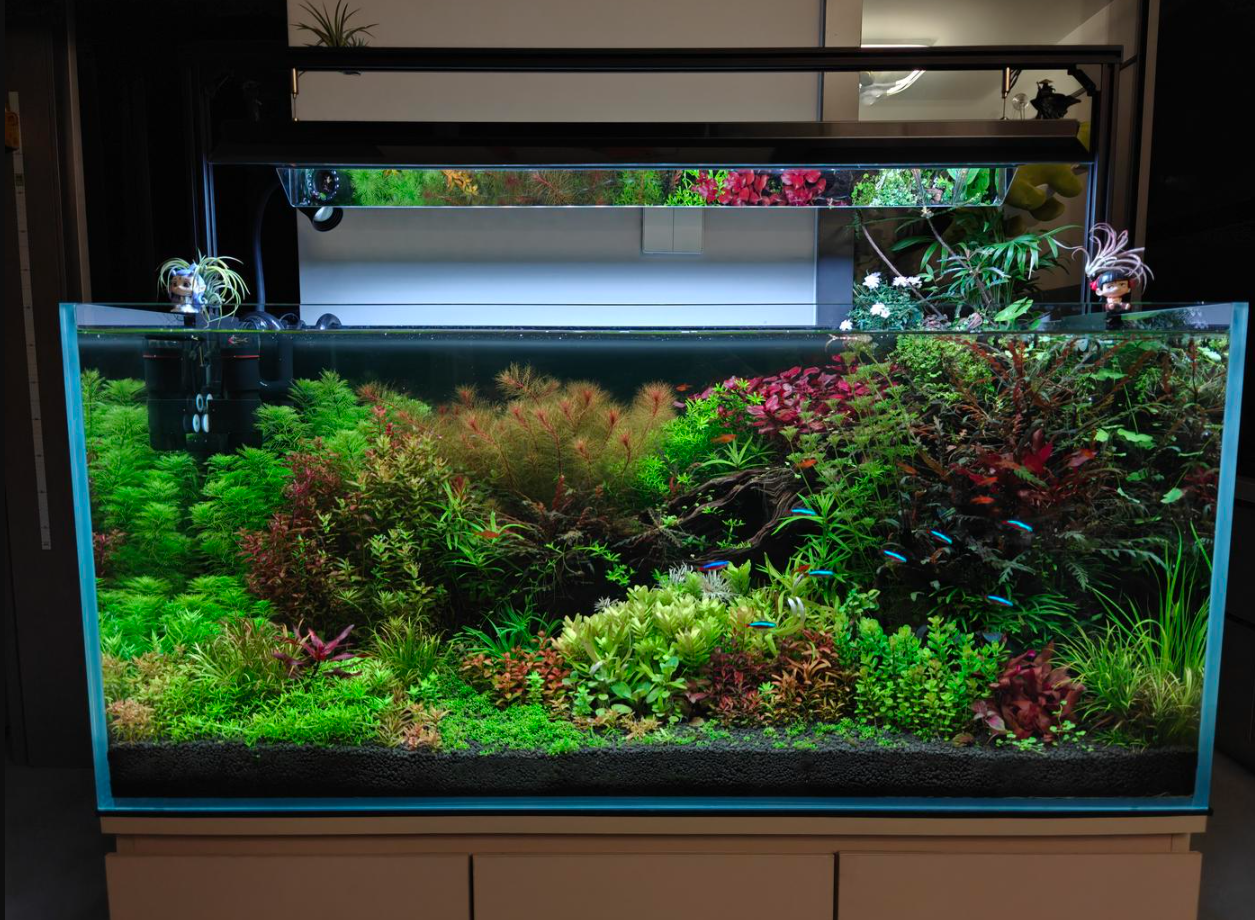
Planted tanks, or aquascapes, can be considered the rising star in the ornamental fish-keeping hobby. While they haven't been mainstream for an extremely long time, their popularity has surged rapidly, amassing a dedicated following. In fact, some aquarists fall so deeply into the planted tank rabbit hole that they become full-blown enthusiasts, utterly captivated and unable to escape the obsession.
Many newcomers to fishkeeping see a beautiful planted aquarium and immediately want to try creating one themselves. However, after consulting with a few seasoned aquascaping veterans, they quickly learn about the apparent necessities: CO₂ injection, specialized aquasoil, various fertilizers, high-intensity lighting, and so on. Faced with this list of requirements, many beginners feel intimidated and decide to back away.
But is the barrier to entry for a planted tank truly that high and difficult? Not at all. This article aims to share a simple, economical, and down-to-earth approach to starting your very own planted tank without breaking the bank.
First, let's acknowledge one thing: If you want to grow demanding aquatic plants to their absolute peak condition—achieving vibrant colors and lush growth—you will need pressurized CO₂ and sufficiently powerful lighting. The advice given by experienced aquascapers regarding equipment isn't wrong. The key distinction lies in the approach: there is a high-budget way to play, and there is a budget-friendly way to play.
Let's take a look at the essential materials for a planted tank.
1. Lighting
All plants require photosynthesis, so lighting is undeniably the most indispensable component of a planted tank. Without adequate light, plant leaves will quickly yellow, wither, and die. You simply cannot keep aquatic plants healthy without it.
However, the light fixtures required for aquatic plants are not as expensive as you might think. The vast majority of common aquatic plants can be grown quite well using standard T5 fluorescent tubes. Even ordinary LED lights can satisfy the light requirements of most low-to-medium light plants. Using a 60cm (2-foot) ultra-clear glass tank as an example, a suitable lighting fixture can be purchased for under $15-20 USD.
2. Substrate
Substrate is the second essential element. Most aquatic plants need a medium in which to anchor their roots. Moreover, a planted tank without substrate looks soulless and incomplete. The simplest solution is to buy commercial aquasoil and pour it in. However, with countless brands of aquasoil flooding the market, it can be difficult to discern quality, and branded aquasoil tends to be rather expensive.
A Budget-Friendly Alternative:
I recommend using agricultural base fertilizer or "Immortal Soil" (a type of organic soil used for bonsai and orchids) mixed with Ceramsite (sintered clay granules). The cultivation results for aquatic plants are excellent.
-
Ceramsite : Base Fertilizer = 6 : 1
-
Ceramsite : Immortal Soil = 3 : 1
This method is incredibly cost-effective. Additionally, the porous structure of ceramsite provides an excellent habitat for beneficial nitrifying bacteria in the substrate, helping to purify the water naturally.
What About Everything Else?
These two items—lighting and substrate—are the only true essentials. Everything else is auxiliary. Simply put, other items are optional, not mandatory.
Some may ask, "What about the filter?" In a setup where the primary focus is on plants and the fish stocking density is low, you can actually get by without a filter. Adding a filter improves water circulation and clarity, making the tank look more dynamic and polished, but it is a useful accessory rather than a strict necessity for a low-tech planted tank.
As for driftwood, stones, and the specific selection of plants and fish species, those choices are entirely up to your personal aesthetic preferences.
A Simple, No-Fuss Setup Process
Let's outline the straightforward, "rough and ready" process for setting up this kind of tank.
Step 1: Preparation
-
Rinse the tank clean.
-
Ceramsite: Give it a quick rinse to remove dust.
-
Aquasoil (if using instead): Do NOT wash aquasoil. It will never run clear and you will just ruin its structure.
-
Base Fertilizer / Immortal Soil: Do not wash these either.
Step 2: Layering the Substrate
-
Place the base fertilizer or Immortal Soil layer first (bottom layer).
-
Cover it with the Ceramsite or Aquasoil (top layer).
-
Lightly mist the substrate to moisten it before planting.
Step 3: Planting and Filling
-
Plant your aquatic plants according to your desired hardscape layout.
-
Fill the tank with water carefully (pour onto a plate or plastic bag to avoid disturbing the substrate).
-
Cycling Period: Let the tank run without fish for 7 to 10 days. If you have a filter, run it. If not, just let the water sit with the plants.
-
Add Fish: After 7-10 days, you can introduce your fish.
Final Tips
-
Initial Instability: The water quality will likely be unstable during the first 1-2 months. This is normal for a new tank.
-
Patience Pays Off: Once the system stabilizes and matures, you will notice the plants entering a phase of rapid, healthy growth.
Recommended Beginner-Friendly Plants
Here are two personal favorites—one for the foreground and one for the background—that are perfect for this style of setup.
1. Glossostigma elatinoides (Glosso)
-
Aquascaping Index: ★★★
-
Popularity Index: ★★☆
-
Difficulty Index: ★★★☆
-
Placement: Foreground
Characteristics & Planting Tips:
Native to Australia (Family: Scrophulariaceae). Height approx. 2.5 cm. It is the quintessential foreground carpeting plant. Parameters: pH 6.2-7.2, Hardness 2-8 °dH, Temp 22-27°C, Lighting: High.
-
Care: It requires a bit of skill and patience to plant. You must use tweezers to plant small individual stems into the substrate. Initially, the bare substrate showing through looks sparse, but once established, it forms a spectacular, lush green carpet. It thrives with strong lighting and CO₂ injection. It performs best in a nutrient-rich substrate like ADA Aquasoil.
-
Alternatives: Dwarf Hairgrass (Eleocharis parvula), Pearl Weed (Hemianthus micranthemoides), Micro Sword (Lilaeopsis brasiliensis).
2. Anubias barteri var. nana (Anubias Nana)
-
Aquascaping Index: ★☆
-
Popularity Index: ★★★★
-
Difficulty Index: ★☆
-
Placement: Midground / Background (attached to wood/rock)
Characteristics & Planting Tips:
Native to Cameroon and West Africa (Family: Araceae). It is a rhizome plant that produces large, oval-shaped leaves with a heart-shaped base. Parameters: pH 6.2-7.2, Hardness 2-5 °dH, Temp 22-26°C, Lighting: Low to Medium.
-
Care: Extremely hardy and adaptable. Highly recommended for absolute beginners. Avoid burying the rhizome in the substrate, or it will rot. Instead, attach it to driftwood or porous rock using cotton thread or fishing line. Be mindful of temperature shock in winter—do not introduce a cold plant directly into a warm tank. This plant is prone to Black Beard Algae (BBA) on its slow-growing leaves, so keeping a few algae-eating shrimp or snails helps maintain its pristine appearance.